Machine Monitoring.
Industry 4.0 monitoring for railway depots
Near real-time machine monitoring, alerts and maintenance for railway depots.
- Client
- CLF Projects
- Industry
- Railways / Industry 4.0
- Engagement
- Build — four audited phases
- Relationship
- A client partnership
The brief.
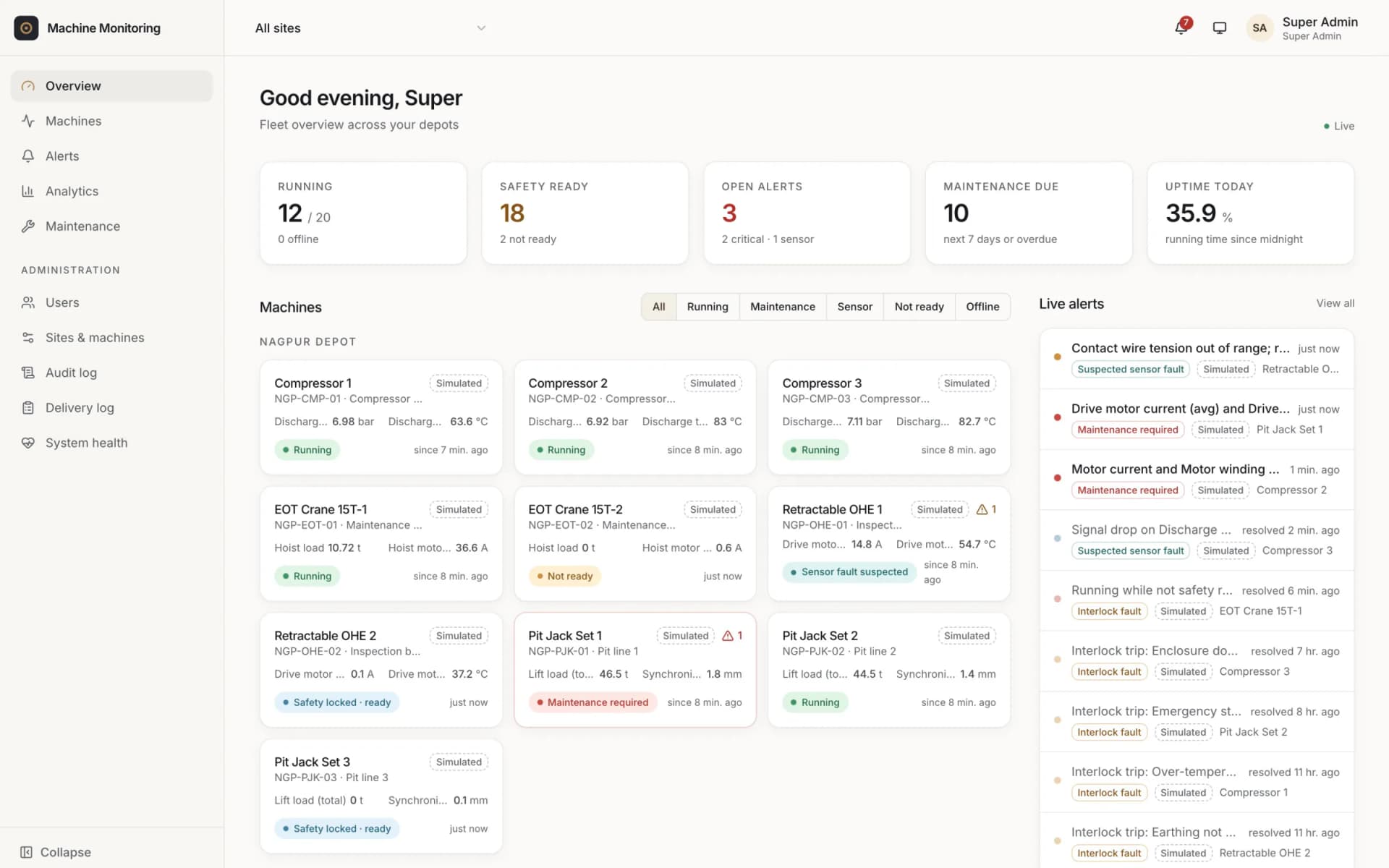
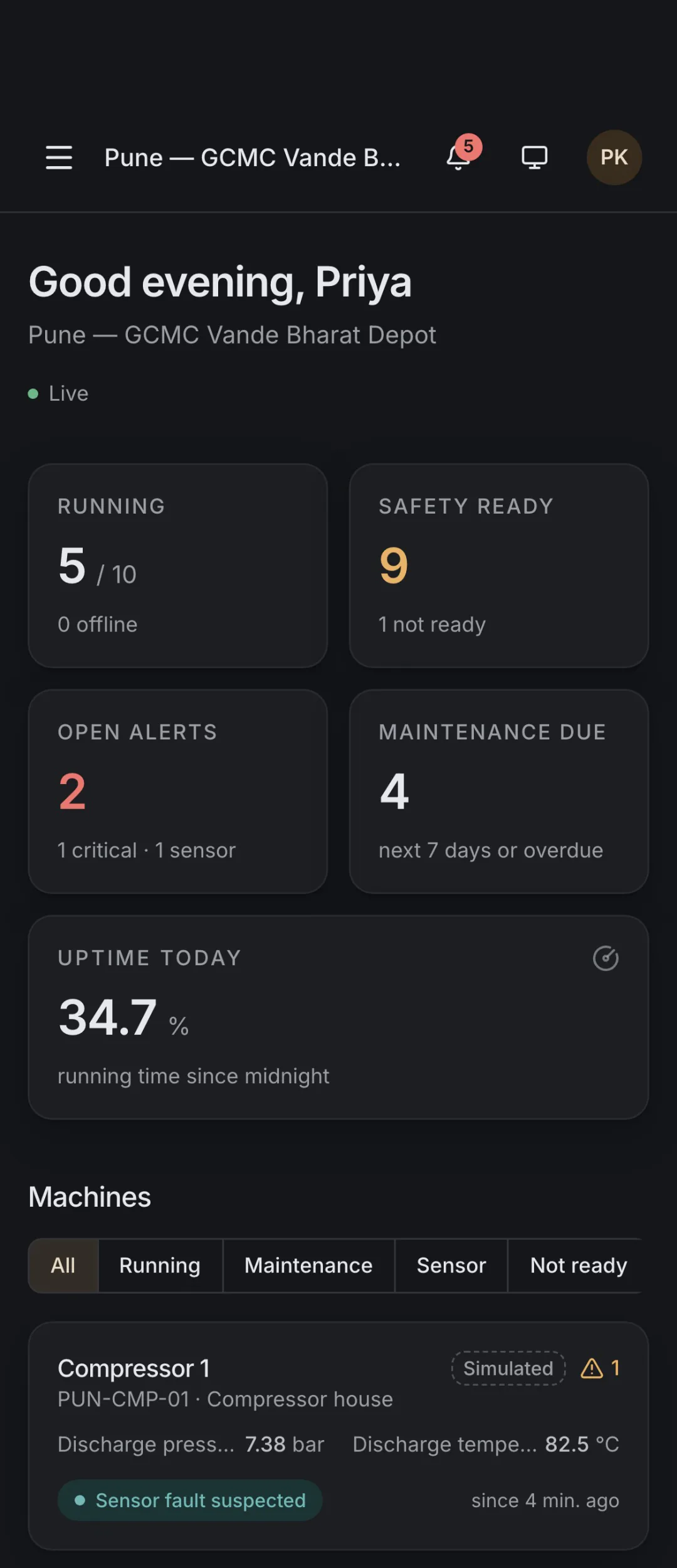
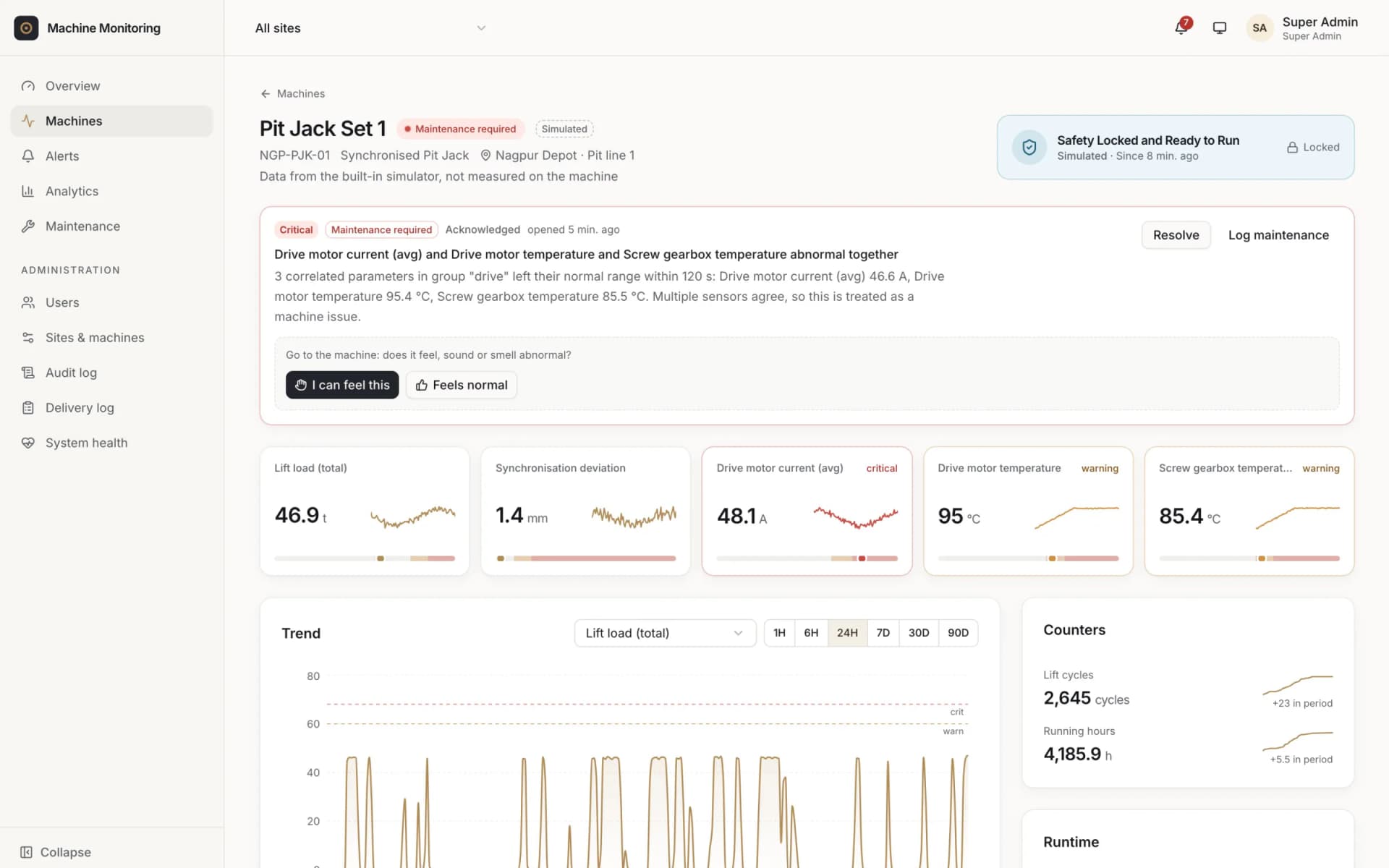
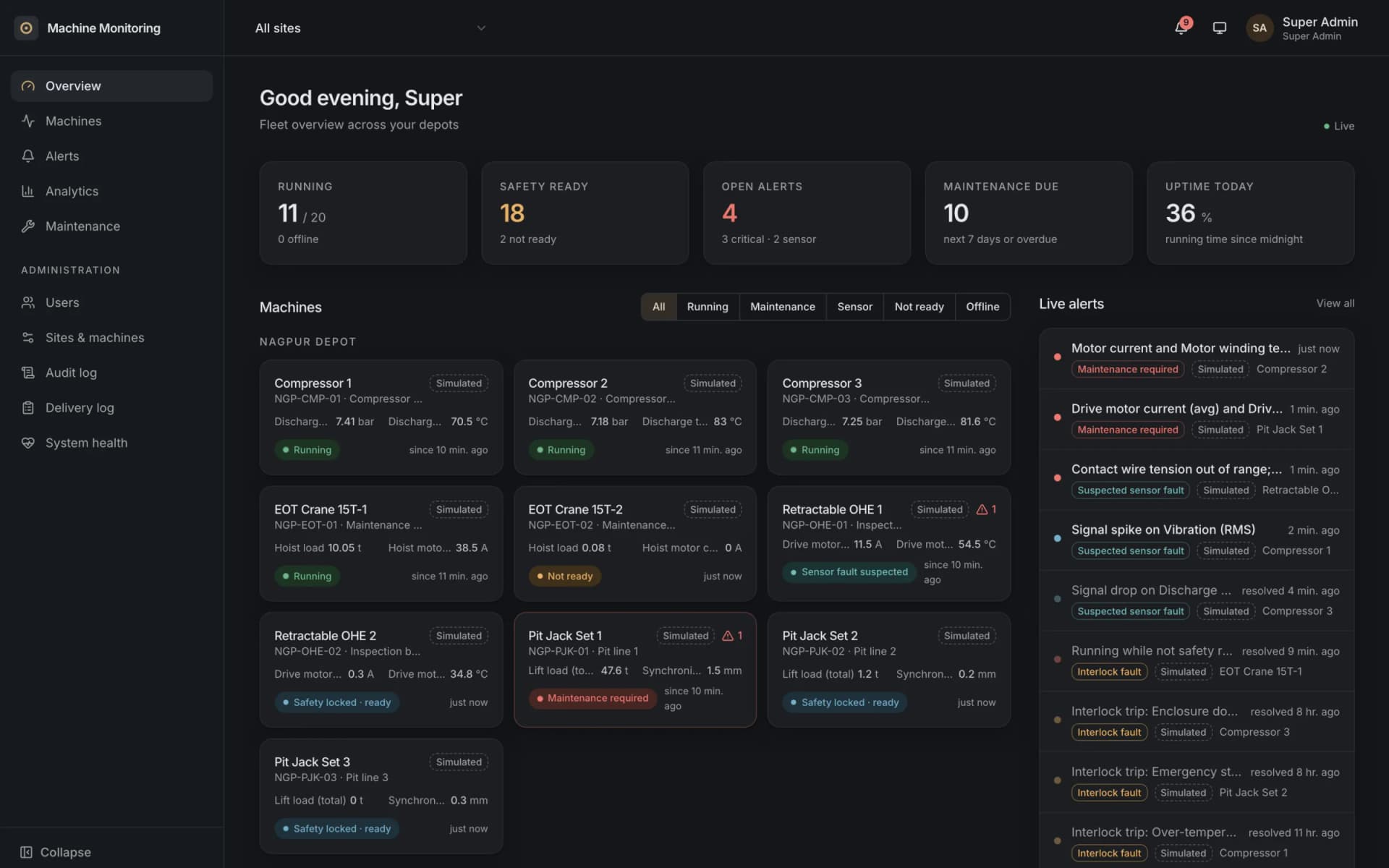
Maintenance teams at railway depots in Pune and Nagpur needed one place to see the state of their machines — compressors, synchronised pit jacks, EOT cranes and retractable OHE — with alerts that tell a real maintenance need apart from a faulty sensor. The system had to run on the depot's own servers, work on everything from a phone to a desktop, keep a clear audit trail and be ready to receive signals from PLCs and edge gateways.
Our response.
We built an on-premises Industry 4.0 platform: a NestJS API with BullMQ jobs, Socket.IO live updates, a built-in simulator and a correlation-based anomaly engine, and a responsive React 19 web app with light and dark themes. When related signals deviate together the platform raises "maintenance required"; when a single signal deviates on its own it flags a suspected sensor fault, and operators can confirm or correct every call. Machine types are data rather than code, and ingestion accepts HTTP push with site-scoped device keys or MQTT. Until PLC and gateway signals are connected, every machine runs on clearly labelled simulated data.
- Product Design
- Full-Stack Web Development
- Real-time Data Pipeline
- Anomaly Detection
- On-premises Deployment
Brick by brick.
- Course 01
Machines as Data
Modelled machine types, signals, limits and correlation groups as configuration, seeded with four depot machine types, so adding a machine needs data, not code.
- Course 02
A Live Pipeline
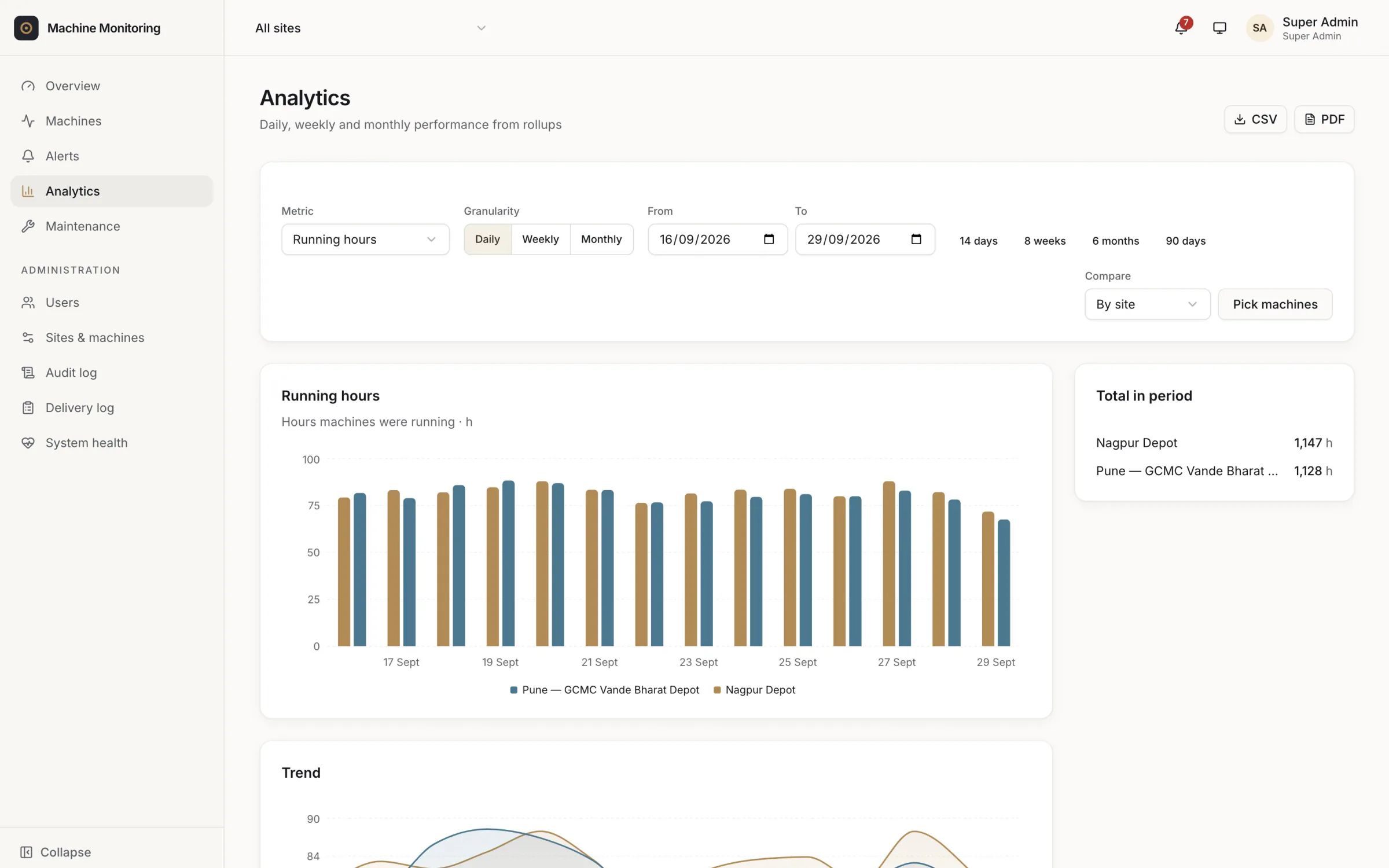
Built ingestion adapters for a physics-based simulator, HTTP push and MQTT, with tag mapping, near real-time updates over Socket.IO and verified downsampling for long-range history.
- Course 03
Alerts Operators Can Trust
Designed the anomaly engine to catch spikes, drops, flatlines, missing data and interlock trips, with an acknowledge-to-resolve workflow and in-app, web push and email notifications.
- Course 04
Secure, Audited, On-premises
Argon2id sign-in with rotating refresh tokens, role-based access for super admins, managers and operators, an audit log, backups and a Docker Compose production stack with TLS.
What it became.
- Web App Routes
- 16
- Fleet, machine detail, alerts, analytics, maintenance and admin
- Automated Tests
- 349
- 169 unit, 120 API end-to-end, 27 Playwright and 33 smoke tests
- Load Test
- 0 errors
- 50 machines at 1 Hz, with every reading stored
- Lighthouse
- 98–100
- Desktop performance, with 100 for accessibility
Project scope and implementation details from Edifio’s case study.
Schedule of materials.
- 01NestJS
- 02React 19
- 03Vite
- 04Tailwind CSS 4
- 05shadcn/ui
- 06Prisma
- 07PostgreSQL
- 08Redis + BullMQ
- 09Socket.IO
- 10MQTT
- 11Web Push
- 12AWS SES
- 13Docker Compose
- 14nginx